Showing posts with label SAP XI. Show all posts

SAP XI What is it ?

SAP XI is an integration technology and platform…
  1. …for SAP and non-SAP applications.
  2. …for A2A and B2B scenarios.
  3. …for asynchronous and synchronous communication.
  4. …for cross-component Business Process Management.
A goal of the Exchange Infrastructure (XI) is to provide a single point of integration for all systems, SAP and non-SAP, inside and outside the corporate boundary.

1.The XI supports B2B as well as A2A exchanges; supports synchronous and asynchronous message exchange; and includes a built-in engine for designing and executing Integration Processes (Business Processes).

2. An important feature of the XI is that it provides openness and transparency to the integration process.
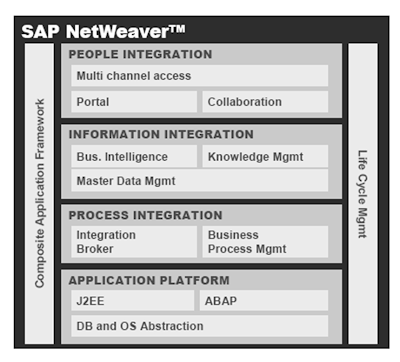
SAP NetWeaver is the integration and application platform for mySAP solutions; XI represents the Process Integration layer of the NetWeaver stack, and is a crucial element of the Enterprise Services Architecture (ESA).

It Unifies and aligns people, information and business processes and

1. Integrates across technologies and organizational boundaries
2. A safe choice with full .NET and J2EE interoperability

The business foundation for SAP and partners

1. Powers business-ready solutions that reduce custom integration

2. Its Enterprise Services Architecture increases business process flexibility(10)
Related Posts :

SAP XI File adapter
XI adapter flow deployment of variants
EDI converter for SAP and EDI standards

ABAP TOPIC WISE COMPLETE COURSE

BDC OOPS ABAP ALE IDOC'S BADI BAPI Syntax Check
Interview Questions ALV Reports with sample code ABAP complete course
ABAP Dictionary SAP Scripts Script Controls Smart Forms
Work Flow Work Flow MM Work Flow SD Communication Interface

SAP XI adapter Flow Deployment of Variants

Three possibilities for deploying the adapter framework (deployment variants):
  1. Central adapter engine (included by default in the Integration Server installation)
  2. Local adapter engine (0 or more based on customer requirements)
  3. PCK (for B2B communication)
The advantage is that the three operate in a consistent way, which provides for easier configuration, maintenance and monitoring.

Related Post

SAP XI connectivity
SAP XI adapter message flow
Syntax for Insert data into Table and Load
You can go through entire syntax check here.
Check SAP SCRIPTS AND SMART FORMS BDC HERE COMPLETELY.
Learn object oriented approach of SAP ABAP HERE COMPLETELY.
ABAP ALE CONFIGURATION
BADI Complete Series and BAPI complete course


SAP XI Adaptar Message flow

This is the simplified flow for a typical message entering the AE from the IS. Communication between the IS and AE is done using the XI-protocol (SOAP w/ attachments) over HTTP(s).

Upon arrival in the J2EE engine the message is queued and persisted as appropriate. These services are provided by the messaging layer.

The message goes through a series of modules (generic and specific, possibly custom written).

The message is posted to the backend application using the appropriate native protocol The core services provided by the AF (described in the previous slide) are leveraged throughout the joutney of the message in the AE.
The PCK is using the same adapter framework providing core services.

Since the PCK is intended to be completely detached from the Integration Server (different business partner), central configuration and adminsitration is not possible.

Therefore the following components have been provided with the PCK Configuration UI (which is really a lean Integration Directory) Monitoring and administration UI.


Related Post

SAP XI connectivity
Syntax for Insert data into Table
You can go through entire syntax check here.
Check SAP SCRIPTS AND SMART FORMS BDC HERE COMPLETELY.
Learn object oriented approach of SAP ABAP HERE COMPLETELY.
ABAP ALE CONFIGURATION
BADI Complete Series and

SAP XI Aarchitecture of the Adapter Frame work

The Adapter framework is the underlying technology supporting most of the XI adapters. The slide shows the internal architecture of the AF.

As a quick walkthrough of the slide, here is an explanation of the numbers present in the diagram:

1: Each specific adapter (developed either by SAP or a third-party) must comply with the JCA 1.0 specification (Java Connector Architecture). For instance, the adapter logic must have a system contract and application contract with the base J2EE engine.

2/3: Internally, each specific adapter is considered as a “module“ attached to the adapter framework module processor.

The module contains the logic specific to a given adapter. New modules can also be developed by the customer when there is a need for custom Java Code at the adapter level. The module is then called like a ‚user exit‘ and must be referenced explicitely in the communication channel configuration. Standard modules from SAP do not need to be referenced explicitely (with the exception of the SOAP adapter).

4: The adapter-specific configuration objects are accessed locally from the CPA Cache, which itself is derived from Integration Directory (central configuration). See the chapter on CPA-cache for more details.

5: The AF provides some administration services common for all adapters (ie monitoring and health check). Most of the administration features are accessible from the runtime workbench. However some AF administration is done in the J2EE Administrator tool directly . The adapter framework has its own persistence layer, which is in the database schema underlying the J2EE engine.

6: low-level technical utilities (threads, transaction management). Standard features of the J2EE engine are leveraged here.

7: logging API: the logging is consistent with the rest of the applications deployed in the J2EE Engine.

8: The message metadata is derived directly from the Integration Repository.

9: The Integration Repository also contains ‚adapter metadata‘. This is how the containers for the adapter-specific configuration are defined. This is also how 3rd parties can define such containers for additional adapters. The adapter metadata translates into adapter-specific configuration screens in the ID. It is consumed by the adapter framework at runtime.

The Adapter Framework resides on the SAP J2EE Engine 6.40. In the case of the JMS and JDBC adapters, the appropriate vendor-specific drivers must be deployed on the J2EE Engine in order to function properly.
Related Post

SAP XI connectivity
Syntax for Insert data into Table
You can go through entire syntax check here.
Check SAP SCRIPTS AND SMART FORMS BDC HERE COMPLETELY.
Learn object oriented approach of SAP ABAP HERE COMPLETELY.
ABAP ALE CONFIGURATION
BADI Complete Series and BAPI complete course

SAP XI Connectivity

PCK is based on the adapter framework.

PCK does not inherit central configuration data from the Integration Directory PCK has its own user interface (which is a subset of the Integration Directory) for configuration of individual adapters.

SAP Partner Connectivity Kit (PCK) is based on Adapter Framework .

SAP PCK‘s objective is to enable XML document exchange between SAP XI and business partner not using SAP XI .

SAP PCK also provides an extensible platform for developing and running individual JCA Resource adapters.

Communication between SAP XI and SAP PCK is via SAP XI messaging protocol SAP PCK Includes the following adapters: File/FTP, JDBC, JMS, SOAP, RFC, IDoc (once available for SAP PCK).

Optionally SAP PCK can host further adapters that are available from SAP or 3rd party adapter providers.

Enablement of smaller companies / subsidiaries to exchange XML documents with their business partner’s / headquarter’s SAP XI as shown below.


platform for development of own JCA Resource Adapters is shown below.

Related Post

You can go through entire syntax check here.
Check SAP SCRIPTS AND SMART FORMS BDC HERE COMPLETELY.
Learn object oriented approach of SAP ABAP HERE COMPLETELY.
ABAP ALE CONFIGURATION
BADI Complete Series and BAPI complete course

SAP XI ADAPTER OVERVIEW

All adapters (including IDoc and HTTP) are configured centrally in the Integration Directory. There you can specify whether an adapter is to be located at the inbound channel (sender adapter) or at the outbound channel (receiver adapter) of an Integration Engine Reuse of Integration Directory’s existing versioning and transport capabilities Central administration and monitoring over adapters, Integration Server, Integration Engine through Runtime Workbench Adapters can be hosted separately, possible on another host The J2EE adapter engine is based on the open JCA architecture. This is part of the J2EE standard.

Read the remaining article about SAP XI ADAPTER ENGINE HERE.